
Need a cheap (£7,000) viable electric car?
100 mile range and motorway speeds in a family car?
Think it can't be done?
Read on.
Have a look around the car and see the technology in the virtual showcase
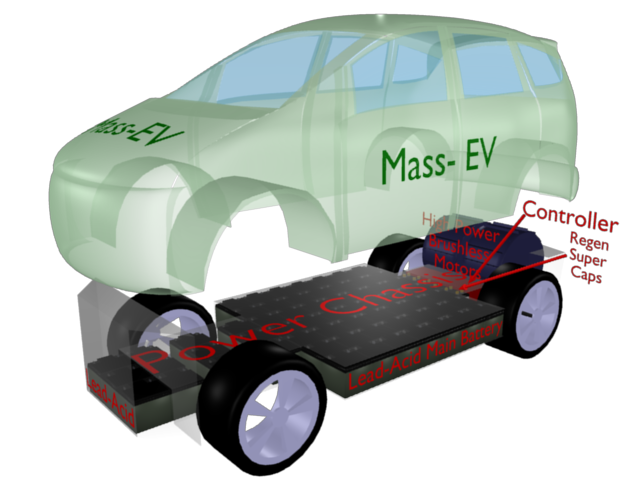
See the patent motor, controller and hybrid technology which will make the Mass-EV unique.
See animations of the car design and the engineering.
See the project progress including full details of the mechanics, electronics and software.
See also full details of the controllers and motors of the Toyota Prius
(including exclusive previously unreleased Prius specifications) in the R & D program.
Total profit after 5 years nearly £47 million with an initial investment of £1,110,000.
Mass-EV Project Plan
100 mile range and motorway speeds in a family car?
Think it can't be done?
Read on.
Have a look around the car and see the technology in the virtual showcase
See the patent motor, controller and hybrid technology which will make the Mass-EV unique.
See animations of the car design and the engineering.
See the project progress including full details of the mechanics, electronics and software.
See also full details of the controllers and motors of the Toyota Prius
(including exclusive previously unreleased Prius specifications) in the R & D program.
Total profit after 5 years nearly £47 million with an initial investment of £1,110,000.
Mass-EV Project Plan
This site is hosted by NetLinux
News:
24th June 2017: Website being restored
Thanks to an old backup and the WayBack Machine this site is finally being restored.
After my cloud facility died I have been slowing restoring this site back as much as I can.
I created a new site on which work was to continue while this site was being restored here
There are still parts missing and perhaps permanently lost, but it seems most of the site is recovered.
20th October 2014: Trinary class-D controller patent being proved
Now the final design is realised and research is being completed, the controller needs to be refined and tested.
Due to the new design of controller a full SPICE model is being developed.
This full prototyping, including PCB testing of the development various stages, is time consuming, but necessary.
This is needed to debug and tune the controller and achieve the target of a low-cost, highly-efficient, powerful, robust controller.
18th June 2014: Patent being prepared for New Trinary Logic Design
The Class-D push-pull design of the new controller will now incorporate trinary (3-state) logic.
This is the first controller to do this.
This means the controller can be very efficient using 3 output BLDC states per phase, but still be safe from shoot through by design.
7th June 2014: Prototype controller design successfully passed.
Today we have a successful test of the class-D push-pull controller circuit.
This is a simple controller design which meets the design specifications required for a production controller.
Next stage is to refine, build and test the full production controller and move to in vehicle testing.
1st May 2014: High speed datalink for controllers
Over the last month a high speed link to be used in the cars is being developed.
This is almost complete and will be designed to work with the 3D display fitted to the cars.
In fitting with the philosophy of the project this is using readily available equipement.
In this case it is using standard PC networking so this makes it very easy for diagnosis by the average computer user.
16th February 2014: Testing on high power motors
Today testing of the new controller on high power motors has started.
This means it is expected an electric vehicle will be on the road within a month.
Older news..
Hide older news..
Also the Class-D push-pull controller design is being finalised and today high power testing has begun.
Two of these will be used in the Impulse-EV turbine-electric supercar.
one MegaWatt of electric power for the 4 high power patent electromagnetic brushless motors.
UPDATE: This is postponed until the new year.
1st February 2014: Hybrid Controller integration complete
The Software flywheel and Synchronous Torque algorithms are now integrated into the Hybrid controller.
The next stage is to revise the electronics to improve the efficiency of the Synchronous Torque algorithm.
So the final design of the controller is not far away.
After that a high power test bed in a real vehicle, which will be on the streets of Reading UK soon.
28th January 2014: Software flywheel controller done
The implementation of the Software flywheel AC synthesis controller is complete.
This means creating a cheap controller is going ahead as planned.
Next stage is to create the full AC synthesis/BLDC hybrid controller, which will start tomorrow.
9th January 2014: New hybrid AC synthesis/BLDC controller project
The AC synthesis feasibility study is now done, so we are going to create a new design of controller.
A combined AC synthesis and BLDC controller is going to be produced, which is another industry first.
This combines the smooth low speed control of AC synthesis with the efficient high speed power of BLDC.
Using the Synchronous Torque algorithm this removes high frequency PWMs at high power so cheaper IGBTs can used.
Also due to the simpler algorithms at high speed this means approval testing will be cheaper.
30th December 2013: New Software Flywheel SVM
Today Turbo Electric is bringing an upgrade to the industry standard SVM (space vector modulation) software design model.
This is moving away from the CPU intensive DQ0 (clarke and park) transforms and replacing this with the fast software flywheel.
This gives the controller the ability to understand the motor and load directly, rather than using mathematical models.
Removing the DQ0 algorithms and using a digital sensor means expensive CPUs and ADCs are no longer needed so making the controller cheaper and more robust.Also the Class-D push-pull controller design is being finalised and today high power testing has begun.
1st December 2013: New direction for the controller
Today the controller technology is being taken in a new direction.
There is a significant overlap between the technology of class-D audio power amplifiers and AC synchronous motor controllers.
A project to test a new kind of class-D push-pull 3-phase controller has been started.
Also the Class-D amplifier technology is quite mature so components are highly available and cheap.
This will also be unique Turbo-Electric technology and means simpler electronics and software can be used so reducing the cost.
16th September 2013: Series wound brushless DC motor patent being tested
This is the unique combination of the Electromagnetic Brushless DC motor and the Simple Split Rail controller.
Both of these are being also independently patented by Turbo Electric Ltd.
The arrangement provides for the ability to connect the 3-phase stator circuit in series with the exciter stator (in the Electromagnetic Brushless DC motor).
This is unique Turbo Electric Ltd technology which provides a powerful yet physically small and cheap electric motor.
The new controller configuration is being tested and early results show it works as expected.
This will provide an effective solution for piston engine car conversion to hybrids using small very powerful hub motors.
9th August 2013: Synchronous Torque software proving stable
The Synchronous Torque software is being developed to put with less strain on the expensive high power components, thus reducing the overall cost of the controller.
This is designed to work at low PWM frequencies so less power is dissipated by the IGBTs (making the controller more efficient) and yet still provide smooth and accurate control.
As a side effect it will also mean the driver will be able to hear the power transmitted to the motor, as will pedestrians and other road users.
The sound from the motor will be similar to a quiet turbo-diesel engine where the turbo sound will be more pronounced at higher power and torque.
This will be used in the test vehicle once it is converted to use a BLDC motor.
3nd July 2013: Low cost controller being field tested
The low cost controller is now moving into the field testing phase.
This means the controller will be running actual motors on real vehicles on real roads.
A simple PWM controller is currently being tested on a series wound motor powering a small van.
This controller will power the van to 40mph using a 8kW motor and will retail at around £100-£200.
The BLDC motor controller will be around £500 retail and will be tested on a 30kW motor fitted to the same van.
It is expected the van will have a top speed of at least 80mph.
29th June 2013: Crowd funding on Kickstarter
As this project is moving quite slowly, we've decided to try crowd funding.
This funding will be used to employ an additional engineer for a short period to move the Mass-EV project on.
A target of £15,000 set on Kickstarter should allow turbo-electric to hire a graduate engineer from the local university and give a good entry on a CV.
3nd March 2013: Second research project close to completion
The details of the synchronous torque controller and the direct driver field electronics are now publicly available.
The direct driver field electronics are close to completion also now.
This means a complete high-power, low-cost controller will be available for purchase in the coming months.
2nd March 2013: First research project completed
Today an assessment of the position sensing electronics project shows that the target of reaching minimum complexity was reached.
This completed part of the controller development means the full controller project is moving towards completion itself.
27rd February 2013: Long term funding secured
Yesterday Turbo Electric has secured long term funding for it's projects.
The funding will provide over £20,000 annually for at least 5 years.
This will secure all the stages of the Mass-EV and take it through to full production.
23rd February 2013: Synchronous torque controller concept proven
Yesterday Turbo Electric proved the synchronous torque controller software in a test rig.
This is a patent strategy to use a simple torque control algorithm for low cost microcontrollers.
The algorithm also uses a low frequency PWM so reducing the cost of the IGBTs and means a complete 30kW controller may cost as little as £500.
Running a low power version on the test rig reveals you do indeed get a sense of the power being applied too.
13th February 2013: Mass-EV to be produced via a 2-stage plan to mass production
Turbo Electric is going ahead with a 2-stage plan to a type approved vehicle and mass production.
The first stage (after the prototype is built) is to start a small scale production operation of around 40 vehicles a year.
The second stage will include type approval and larger scale production.
This plan is practical as it can be done on the current internal investment model and with the current facilities.
More details in the plan.
11th February 2013: EV0 Trailer Generator progressing
The trailer generator project is to provide power for an electric vehicle from petrol.
This effectively makes a hybrid vehicle from an electric one.
The project is pursued at this stage for long distance testing of vehicles without buying battery packs.
You can follow the progress on the project page.
30th January 2013: Alcatel-Lucent funding cut short
Alcatel-Lucent have ceased some projects due to client legacy requirements.
For Turbo Electric this means progress may be slow until further funding is sourced.
If you are aware of any funding available to invest please contact Turbo Electric using the Contacts page.
Turbo Electric is also again looking into crowd funding to source project revenue.
26th January 2013: EV0b completed 3 road tests successfully
This is the EV0b test rig with a series wound milk float motor.
The point of these tests were to assess the mechanics for robustness, which it passed.
Please see the EV0 Mechanics page for full details.
The next stage is to upgrade EV0b to using a brushless motor to test the patent brushless controller.
The upgrade will be started this week, which means EV0b could be doing motorway speeds at the end of this month.
12th January 2013: EV0b being completed this week
The EV0 project was a test rig for the Mass-EV components.
This is a converted Daihatsu HiJet initially using a series wound motor from a milk float.
This will be completed this week to become the first Turbo Electric vehicle on the road.
12th November 2012: Turbo Electric working with Alcatel-Lucent
Today Turbo Electric has started work on Alcatel-Lucents new 4G mobile systems.
Again while not electric car technology this will provide at least a further £27,000 of funding.
Due to the amount of work required it may provide up to £100,000 over 2 years.
Turbo Electric Ltd will now considering hiring engineers in the new year to accelerate development.9th November 2012: New patent design of controller
This week Turbo Electric Ltd is testing a new design of controller.
This is not a standard BLDC nor AC synchronous controller, but a new synchronous torque controller.
It works by allowing the motor to control it's own torque and the user controls only the power required.
This means the controller software is very simple so will be targeted as safety critical systems also.
As ever, the design will be published when the patent application is sent.
As there are 3 designs awaiting patent application this will happen some time in the next month.12th October 2012: Finalising controller development
Given the successful testing of the patent split-rail,
which is designed to compete with other 50kW controllers at twice the price,
this is moving into the final productisation phase.
Once this is complete and final vehicle testing is completed this will be available for sale.
This provides a 50kW brushless motor controller at a target retail price of £1,400 sometime early next year.8th August 2012: The parts of Mass-EV are coming together
Testing of the HV battery charger are moving to the final phase.
Prototype test motor, mechanics and battery are sourced and being prepared for installation.
The new low-cost, high-reliability controller is about to be proved on a real vehicle.
The base of the power chassis is moving to completion.
Time to start looking at the body construction.1st August 2012: Qualcomm funding continues
Earlier this week Turbo Electric Ltd discussed extending the project at Qualcomm to which they have agreed.
This funding from a Qualcomm project not related to electric cars will provide a further £10,000 funding for Turbo Electric projects.16th July 2012: Mass-EV power chassis construction is taking shape.
The progress of the Mass-EV prototype is slow but steady.
Finally started updating this site with the progress.
You can watch construction on the WorkshopWebcam and track the details on the project page16th May 2012: Mass-EV power chassis construction is being started.
This week the focus is on starting the physical construction of the Mass-EV.
The workshop at Milford Road has been prepared for the construction of the Mass-EV base chassis.
Turbo Electric Ltd is also working with other businesses close by to prepare other parts of the Mass-EV.
This is started now to target prototype completion summer (Q2) 2012.7th May 2012: Testing Begun on the High Voltage Charger.
Since we are heading toward a real prototype we are going to need the ability the charge it's battery.
Today work has begun developing and testing the high voltage charger.
This will be used to charge the lead acid packs for the Mass-EV, but also can be used to charge Prius hybrid batteries.
At a cost of around £50 it will form yet another cheap, but reliable component of the Mass-EV.
You can follow progress on the project page.7th April 2012: Prius EV mode controller successfully tested.
Recently Turbo Electric has been testing the new design of controller on a Prius.
This is to simplify development as a Prius already has the mechanical arrangement to test a controller.
The amazingly simple £600 controller performed much better than expected obtaining 10mph from a 12v standard car battery.
The car will be capable of motorway speed from the original 300v powerpack without requiring a fuel engine.
The full controller will be published once the patent application is processed.14th March 2012: Further controller improvements.
Over the last couple of weeks a new controller is emerging from Turbo Electric Ltd which is radically simpler than anything currently used.
This new controller is designed with directly coupled gate driver circuits currently unheard of in the brushless motor world.
This could revolutionise the design of all electric vehicle controllers as it would make them far cheaper than is currently costed.
Details will be published as the patents are applied.13th February 2012: Work is started on the second car.
Preparations are under way for the 2000 Fiat Punto.
There are a few people interested in buying this when it is ready.9th February 2012: Turbo Electric Ltd working with Qualcomm
Turbo Electric has accepted a contract to work on one of Qualcomms embedded systems.
Whilst not a Qualcomm electric car project it indirectly provides funding for Turbo Electric Ltd projects.
The contract with Vitec will be renegotiated to enable the work to continue.
This will provide at least a further £40,000 of funding to continue the research.27th January 2012: Turbo Electric Ltd working with The Vitec Group plc
Today Turbo Electric Ltd accepted a contract to help Vitec with some of their robotics projects.
This contract provides around £40,000 of funding to continue the ongoing research in controller and motor technology patents.
Some of this funding will also be used to develop the new car trading venture.19th January 2012: Improved Controller Electronics will be Patented
Today Turbo Electric Ltd has prepared an improved design of controller circuit.
The circuit improves the Simple Split-Rail Brushless Motor Controller by adding a class D push-pull driver stage.
This design reduces the load on internal components and increases switch speed in the controller.
Reducing the load means lower cost power output stages can be used (the most expensive part).
This makes the controller more efficient and also considerably lowers the controller cost.
Full details will be posted when the new controller design is filed.10th January 2012: Oracle Corporation Withdrew Complaining Lack of Funds
Today Turbo Electric Ltd was told that Oracle have withdrawn from their contract.
Turbo Electric Ltd is now in discussion with Oracle as to what why they made the commitment and then consequently withdrew.
Whilst obviously an initial setback this will hopefully not impact the goal of having a prototype for 2012 summer.9th January 2012: New Design of Controller will be Patented
Over the last week Turbo Electric Ltd has been testing a new controller concept for Brushless motor control.
This design adopts a drastically simpler algorithm than the industry standard direct-quadrature-zero (or dq0 or dqo) transformation used in AC synthesis.
The new algorithm currently is being tested on a 4Mhz processor requiring less than 1k of combined memory and can run at shaft speeds over 100,000 RPM possibly even up to 500,000 RPM.
The code is currently less than 400 lines of assembler so will be cheap to gain safety critical compliance.16th December 2011: Turbo Electric Ltd working with Oracle Corporation
Today Turbo Electric Ltd has accepted a contract with Oracle to work on an IT project of theirs.
Depending on the amount of work required on the project the contract will be worth at least £20,000 and may be up to £60,000.
This will provide funding for the rapidly approaching first Mass-EV prototype.7th December 2011: Trakwerks collaborating in turbine generator projects
Today Turbo Electric Ltd discussed with Trakwerks details of prototyping the Decoupled Turbine Generator and Multistage Micro-Turbine Generator Projects.
We agreed to start the engineering and testing of these project in January 2012.
Once these patents are tested and experimental data is assessed, Turbo Electric Ltd will be moving ahead with the Impulse-EV supercar project.1st December 2011: Local motorsport company interested in collaborating
Today motorsport company Trakwerks approached Turbo Electric Ltd with a view to collaborating on projects.
Trakwerks is run by professional motorsport engineers who are great car enthusiasts.
They expressed interest in the potential of electric power in a performance vehicle about which Turbo Electric Ltd is also very enthusiastic.28th November 2011: Starting car sales
Starting today Turbo Electric Ltd is trading hybrid and electric cars.
This will create market awareness of the Turbo Electric Ltd brand name.
It is also an opportunity to gain valuable experience of customer needs and maintaining a good reputation.25th November 2011: Preliminary EV controller tested
Turbo Electric has successfully completed phase one of the patent low cost EV controller.
Phase one is a low technology, dumb controller to prove the basic electrics and software.
This was successfully tested on a Prius as a replacement for the HSD to power the Prius as an electric only vehicle.
This means moving on to Phase two which involves full motor output control.
Also Turbo Electric are looking to prove the high-RPM, low-cost BLDC motor patent before January next year.
This motor will be part of the prototype power chassis being build in January 2012.7th November 2011: Moving to new premises
Turbo Electric Ltd is now located at Milford Road.
Keys were obtained today and the experimental vehicles and equipment are being moved there this week.
You are quite welcome to come and see.
A webcam is planned also.25th October 2011: Micro Turbine Patent Submitted
Finally the design for the multi-stage micro-turbine has been submitted.
This is a revolutionary design which should reach the goal of a viable micro-turbine engine for electric cars.
It is a complicated design involving multiple compressors and turbines, a large heat exchanger and it's own ECU.
An experimental prototype will be built once Turbo-Electric Ltd moves to it's new premises early November this year.
This engine is targeted at the Impulse-EV supercar project, but a "range extender" unit will be built for the Mass-EV also.14th October 2011: Low-Cost Controller Patent Submitted
A design for a new low-cost brushless motor controller has been submitted.
This is in keeping with bringing new low cost technologies to make the Mass-EV possible within the target price.
This design has been almost fully proven in the The Mass EV Electronics Lab so this is almost ready for production.12th October 2011: Workshop Premises Secured
Given the requirement for several vehicles to be worked on concurrently, Turbo Electric Ltd is moving from it's current workshop in west reading to a 1,500 sq ft unit on Milford Road Trading Estate, Reading.
This is nearer to the centre of reading close to Rivermead Leisure Centre.
This will enable rapid building of the prototype Mass-EV and conversion of the EV0 as well as the EV conversion of the White Gen 1 Prius shown on the Research Lab pages.11th October 2011: Further funding phase complete
A further small funding phase for Turbo-Electric Ltd is now complete.
This means Turbo Electric Ltd with now move into another engineering phase.
Watch this space.7th October 2011: Turbo-Electric Talking to the new generation
Turbo-Electric Ltd has been invited to talk about the electric cars as a local primary school.
This is a nice opportunity to inspire future scientists, engineers and users in what is widely accepted as the future of motoring.3th October 2011: EV0 upgraded
Project EV0 has been upgraded due to design issues.
The original Fiat 126 EV0 is upgraded to a Daihatsui HiJet EV0.
The decision to replace the Fiat chassis with the Daihatsui van chassis was due mainly to weight problems.
The Fiat chassis was found not to be capable of supporting the weight of a heavy electric motor and battery.
The Daihatsui HiJet was purchased over the weekend and work will commence to convert it this week.13th August 2011: EV0 completion started
The project which started all this now named EV0 is heading toward completion.
This is a Fiat 126 purchased about 3 years ago with the intention to turn it into an electric vehicle.
Fiat 126 is a very small car which is powered by a 650cc 2-cylinder air cooled rear petrol engine.
A milk float motor will replace the petrol engine which is extracted from the now scrapped milk float.
This will be fitted some time this week.29th July 2011: Prototype Chassis Fabrication to start soon
Today Turbo Electric Ltd has commissioned building of the prototype power chassis.
A local company have committed to building the chassis and are due to start work soon.
They have also interesting ideas for the body which they may be able to fabricate in aluminium rather than fibreglass.19th July 2011: Full prototype funding obtained
Today Turbo Electric Ltd obtained full funding for the Mass-EV prototype from their bank.
This means construction of the Mass-EV prototype will commence this month.
It is hoped that this prototype will be completed before the winter this year.
This prototype will include of all patent technologies to date plus further patents will be pursued on the complete powertrain due to its unique combination.27th May 2011: New design of micro-turbine
Today Turbo Electric Ltd is preparing a new design of micro-turbine building on the design of the Decoupled Turbine Generator.
This is a multi-stage version of the single-stage Turbine Generator capable of high efficiency at low speeds.
The micro-turbine will be capable of in the region of 150kW max output.Two of these will be used in the Impulse-EV turbine-electric supercar.
8th May 2011: New supercar design project
Given the market investment attracted by high performance electric vehicles, Turbo Elecric Ltd has started a new design using Mass-EV patent technology called the Impulse-EV.
This will be a hybrid vehicle with a design specification of 200mph, 0-60mph in 4 secs, yet still attain 100mpg and have a range of 500miles.
Power will be provided with a petrol version of the patent decoupled gas turbine generator to provide the 4th February 2011: ST extended contract with Turbo Electric
Due to the success of the work so far, ST Microelectronics offered to further work with Turbo Electric. This will provide an additional £26,000, which means a full prototype of the Mass-EV1 could be ready this summer. Turbo Electric is also preparing further patents to protect the unique powertrain of the Mass-EV1.27th October 2010: Turbo Electric working with ST
Turbo Electric have signed a contract to work with ST Microelectronics to work on some of the microprocessor systems for a range of future products. This will provide a further £26,000 prototyping funding and invaluable systems experience. ST have more than 20 years of experience in the automotive market, including Hybrid and Electric Vehicle Solutions.28th June 2010: Turbo Electric working with the Beeb
Turbo Electric have signed a contract to work with BBC Research and Development to work on the Ingex Project. While not strictly about electric cars, this will provide £45,000 prototyping funding and the Ingex project is currently being tested in the studio of the BBC program Dragon's Den (which may open up it's own doors!)18th May 2010: Graham North to speak at London Transport Museum
The London Transport Museum have contacted Turbo Electric Ltd to ask for Graham North to speak at a breakfast event in October. Turbo Electric will have a prototype available for viewing in London. More details available as they are finalised.UPDATE: This is postponed until the new year.
23rd Mar 2010: Next stage for Mass-EV patents
The first 2 Mass-EV patents will be published within a month. These are the "Brushless DC Motor without Permanent Magnets" (GB1001919.8) and "Brushless Motor Resonant Controller" (GB0904679.8). A third is also expect to move to the publishing stage some time this week.4th Mar 2010: In the news again!
The Mass-EV Project appeared again in The Reading Chronicle again. The piece tells of the 3 patents and how I'm using a milk float to prove the range and speed of the powertrain. I wil add the piece as soon as it's available online.3th Mar 2010: International engineering company involved
Turbo Electric is currently talking to Goodrich about the application of two Mass-EV patents "Brushless DC Motor without Permanent Magnets" (GB1001919.8) and "Decoupled Gas Turbine Generator" (GB1001921.4).11th Feb 2010: Green Party Conference
After speaking to Adrian Windisch (Reading Green Party candidate) Turbo Electric Ltd will be at the Green Party Spring Conference 2010 on 18th to 21st February. Turbo Electric is looking to work with green organisations including the Green Party in the design of the car.8th Feb 2010: Website tidy
The website has had some minor improvements to make it more pleasing. Some overhaul of the underlying code was also cleared up to fix some issues with new browsers.5th Feb 2010: 2 more patents
Today Turbo Electric Ltd filed 2 more patents relating to the Mass-EV.
That makes 3 in total: "Brushless Motor Resonating Controller" patent (filed 19th March 2009), "Brushless Motor without Permanent Magnets" and "Decoupled Turbine Generator" (filed today).28th Jan 2010: Going full time
Graham North now goes full-time on the Mass-EV project.
Previously, He was in other contracts and only part-time on Mass-EV.
More achievements are available on the project page